Thursday, April 30, 2015

San Antonio Missions

While in San Antonio Texas we made sure to visit the missions that were so important in the development of the city itself and southern Texas by allowing the native population to be colonized.

In the early 1700's the missions were the only true defense against attacking Apaches, sickness, and drought.   All the native Indians had to do is agree to become citizens of Spain, support the king, and accept the Catholic beliefs as their religion.

Spain wanted to keep a foothold in the area especially with the French encroachments from Louisiana and missions were a way of doing that.  They were the most successful between 1745 and 1780 until increased Indian attacks, lack of sufficient military support, and disease caused their later decline.

The first mission on the San Antonio River was the Mission San Antonio de Valero or the Alamo as we know it today.  It is not part of the National Park's San Antonio Missions since it is owned by the state of Texas and managed by the Daughters of the Republic of Texas.
Tia, Courtney, Ethan, Misty, Avery, Don, Chloe, and Ian in front of the Alamo.
The next mission on the San Antonio river is the Mission Nuestra Senora de la Purisima Concepcion.  It is considered the oldest unrestored stone church in America.

Avery, Ethan, Ian, Courtney, Tia, and Chloe at Mission Concepcion.
Mission Concepcion.
The sanctuary for Mission Concepcion.
One of the surviving interior wall paintings.
Another wall painting.
Mission Concepcion also had its own rock quarry which provided stones for its buildings and for portions of Mission San Jose.
Stone quarry for Mission Concepcion and portions of Mission San Jose.

The next mission on the river is the best known of the Texas missions, San Jose y San Miguel del Aguayo  or San Jose for short.  

Not only was it the biggest of all the San Antonio Missions, but was also considered to be a "model mission organization".  It was a major social center, had a unique church architecture, and had prospering fields and pastures.  This is why it was nicknamed, "Queen of the Missions."
Mission San Jose, the "Queen of the Missions."
Mission San Jose.
The below Rosa's Window or Rose Window shows off the Spanish artisans' high level of skill when it came to fine details in their building techniques.
Another view of Mission San Jose to include the Rose Window located in the middle.
Ethan, Chloe, Avery, Courtney, Ian, and Tia in front of the Rose Window.
Mission San Jose's sanctuary.

The grist mill, that was built late in the mission period, never did grind corn, but only wheat since the mission Indians had grown so accustomed to foods made from wheat and not corn.
Grist mill at Mission San Jose.
Back side entrance to the grist mill at Mission San Jose.
San Jose also had a much larger wall which included bastions with firing ports to let it be easily defended.  This gave the defenders of the mission a better perspective when firing at any attackers.
The kids looking into a firing port at one of the bastions at Mission San Jose.
Looking out one of the firing ports on a bastion at Mission San Jose.
The next mission south on the river is Mission San Juan Capistrano which was originally named San Jose de los Nazonis when in East Texas, but was renamed when moved to the San Antonio River in 1731.
Ian, Avery, Ethan, Courtney, Chloe, and Tia at Mission San Juan.
Mission San Juan.
The sanctuary at Mission San Juan.

All of the missions, except for the Alamo, still hold Catholic services on Saturday and Sundays.  At Mission San Juan the priest still lives in one of the original buildings on the mission grounds.
Private residence for the priest at Mission San Juan.
Some of the remaining walls still standing at Mission San Juan.
Once of the entry ways into Mission San Juan.
The best attraction, according to the kids, at Mission San Juan was the cat sunning on a window ledge.  You can see Ethan's concern when the cat arched its back to stretch.  He is such a silly boy!
The kids favorite attraction at Mission San Juan.
The last of the San Antonio Missions is also the oldest one which was founded in 1690 in East Texas and then moved on to the San Antonio River in 1731.

It was originally named San Francisco de los Tejas but renamed San Francisco de la Espada.
Courtney, Ethan, Avery, Ian, Chloe, and Tia at Mission Espada.
While we were visiting this mission the kids completed their Junior Park Ranger books and earned their badges which we will use as a good example of something learned of our field trips while homeschooling.
Chloe, Tia, Courtney, Ethan, Avery, and Ian taking the Junior Park Ranger pledge.
And to the victors go the spoils or at least the Junior Park Ranger badge.
After all of that excitement we toured the mission and then walked the Riverwalk from it to Mission San Juan which is a good three miles up river.
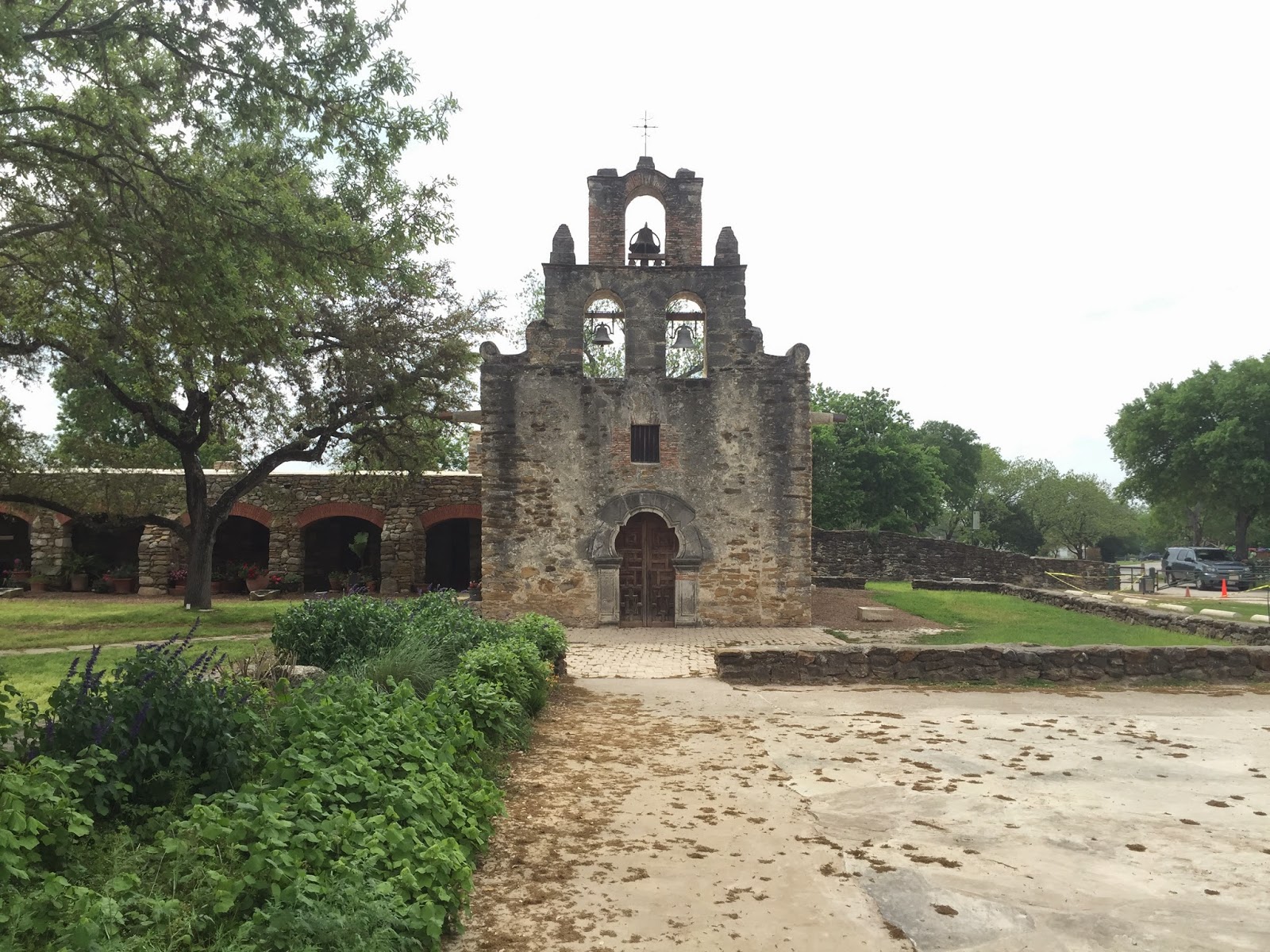
Church at Mission Espada.
Church sanctuary at Mission Espada.
Some of the fortifications on the back side of Mission Espada.
After we explored the mission then we set out to walk to the Espada Aqueduct which is two centuries old and still works to provide water to the acequia madre (mother ditch) that farms still use to this day.  It is considered the oldest Spanish aqueduct in the United States.
Arches for the two centuries old Espada Aqueduct.
Water being held in the aqueduct.
Another view of the still working aqueduct for Mission Espada.
Even though the next picture is in the fields of Mission San Juan, you can see how an aqueduct directs water to the crops.
Gates to control the water flow to the fields.

The water outlet to one of the fields at Mission San Juan.
After looking at the aqueducts we finished our walk back up to Mission San Juan and back around to Mission Espada.  Needless to say we were a little tired and sore after walking the six plus miles.

We had a backpack with water, apples, oranges, trail mix, and Peeps left over from Easter.  We decided that we would save the Peeps for the last treat once we were about a mile out in our journey to give the kids that little extra jolt of energy to finish the hike.  We did not want to give it to them too early just to have them burn out with some distance still to walk.
The Riverwalk next to Mission Espada.
Walking on the Riverwalk on the east side of the San Antonio River.
Misty, Chloe, and Don on the Riverwalk between Mission Espada and Mission San Juan. 

A view of the San Antonio River near Mission Espada from the Riverwalk.
Another part of the Riverwalk near Mission Espada.
The kids getting some water at one of the many water fountains on this portion of the Riverwalk.
The path off of the Riverwalk to the Espada Aqueduct.
Some old mill ruins on the Riverwalk from a long lost community.
I wish I could post all of the pictures we took while touring the Missions of San Antonio and strolling along the Riverwalk, but time just does not permit it.

If you are ever in San Antonio, Texas, you have to visit the mission trail and see them all for yourself.  It is well worth the trip!

If you like our blog then please comment below and sign up to follow us.  You can also become our friends on Facebook using the links on the upper right of this blog.

We hope you enjoyed our little view of our mission tours and do hope you make it here one day to do the same.

Once again we are so blessed by God that we can see such wonderful sights as we travel across America.

God bless and Thanks!

Don, Misty, and Kids...

States we have visited so far.


Thursday, April 2, 2015

Easter Special 2015

One day while browsing on Facebook I came across a post that showed an individual coloring Easter Eggs using rice in cups and food coloring and how it kept the mess down, plus gave the eggs a really nice texture.

Well, I figured I would give it a try this year with the kids since it seemed so easy.

I went to H.E.B and bought some little snack containers that were around $1.97 for six, some food coloring, and two dozen white eggs for a total cost of around $12.00.  We already had the white rice where we bought a 50 lb bag a while ago.
Our supplies to color Easter eggs this year.
The kids and I then put about an inch of white rice in the bottom of each container and then added the food coloring.  We started off with purple.

We also started a pot of water to boil to cook the eggs.  We always get our salted water boiling and then drop the eggs in with a ladle which we think makes them easier to peel.  Not 100% if that really works, but all of the eggs we have hard boiled do seem to peel easier since we started using that method.  Once we add in the eggs to the hot water we let them boil for twenty minutes, remove them from the heat, and run cold water over them until they are cool to the touch.
Hard boiled eggs.
Now it was time to add the rest of our colors to the rice and start dying eggs.
Pink
Orange
Green
Since we only had six containers the colors we used were blue, green, orange, pink, purple, and yellow.  The ratio of food coloring to rice was probably important, but we just winged it.

In the video I watched, the rice did not stick to the eggs quite as bad as it did with our eggs.  I added a little bit of water to some of the containers to try and thin it out so the rice maybe would not stick to the eggs as bad.  It helped some, but also messed up the shade.
Add one hard boiled egg.
Close the lid and shake until the egg is completely covered.
We may have too much food coloring in this one.
Waiting for the eggs to dry so the rice will fall off.
As far as not being as messy as the traditional method used to color Easter eggs, well I'll let you be the judge of that.  We really tried to do it a clean as possible, but fell short of our goal.

As you can see below, there was a mess after we were done with food coloring all over the place not to mention the rice.  
The after mass of dying our Easter eggs using the rice method.
This was after brushing off the rice clinging to the eggs after they had dried some.
This does not wash off easily, so I guess my hands will be stained for a few days.
After we were done, I just threw all of the containers away.  If you use good plastic containers, they may stain and with the kids I do not like to use our glass cups or containers due to them maybe breaking.
All of the containers in the trash.
All in all I would say that it was not any easier using this method over the traditional method of dipping the eggs in the liquid coloring solution.  Maybe if you bought a kit it would have everything proportioned out properly so that you would have better results.  If so you could comment and let us know.

We think our eggs turned out OK, but really they are not so special that we can say the rice method is best.  You can judge for yourself.
Our finished product using the rice method to color our Easter eggs.
We do need to remember that the eggs are not the important part of Easter, but the fact that Jesus Christ rose from the dead and saved us from our sins.

All of our kids know there is no Easter Bunny and that Easter is not about the candy, the outfits, or the eggs, but about how we are saved by Jesus Christ who died on the cross for us.

We tell our kids not to let other children know there is no Easter Bunny because some parents want to keep up that tradition, but as for our kids, they know the truth because we never want them to grow up and question whether Jesus was also a made up story. 

We also still let them participate in Easter egg hunts and get them candy on Easter, but remind them, that is not what it is really about.

I love the below cartoon, which sums it up pretty good.
So true!
So we had our fun coloring our eggs and will have just as much fun eating them on Easter Sunday or after.  Next year we may do it the traditional way or maybe I will find another way of coloring our Easter eggs and try that.  

But we will always remember that we are blessed that God saved us by sending His son Jesus Christ to die on the cross for us.

God bless you all and may you have a wonderful Easter Sunday!

Thanks!
Don, Misty, and Kids...


States we have visited so far.